
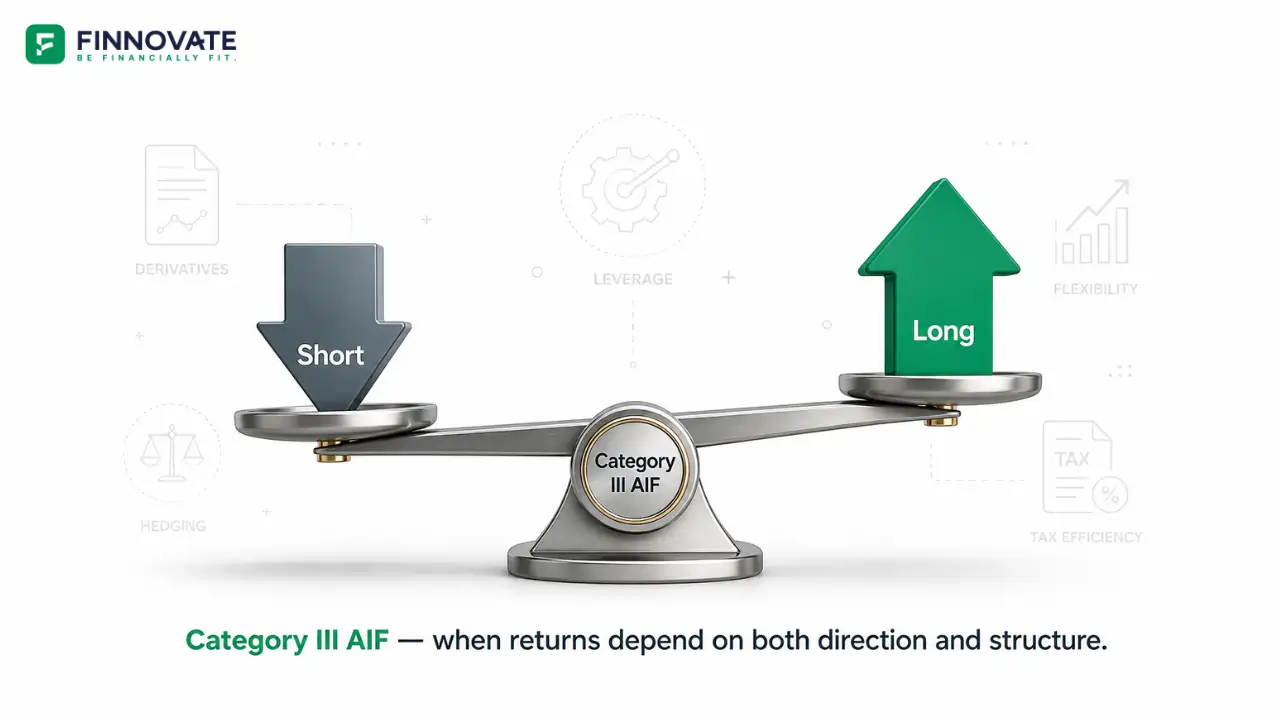
Category III AIF in India: Strategies, Tax and PMS Comparison
Pitched a Category III AIF when you already have a PMS? Read the post-tax comparison befor...
05 May 2026

Updated: May 2026 | For HNIs, NRIs and Professionals
AIF taxation in India works at two levels: either income passes through to the investor who pays tax based on the income's nature, or the fund pays tax before distributing. The AIF category, the type of income generated, and the investor's residential status together decide which applies.
Two AIFs can show the same gross return on paper and leave very different amounts in your hand after tax. The gap is not always small. Depending on the fund's income mix, the AIF category, and your own tax profile, the post-tax outcome can differ by tens of lakhs on the same invested amount. Same headline return. Very different money kept.
The difference is not just the fund manager. It is the tax structure, the type of income, the AIF category, and the investor's own tax profile. Category I, II, and III AIFs are not taxed the same way, and within each category, whether income is capital gains, interest, dividend, or business income changes the result further.
Main rule: Do not compare AIFs only on gross returns. Compare them on post-tax, post-fee, post-cash-flow returns.
AIF taxation works at two possible levels. Either the income passes through to the investor, or the fund pays tax first and distributes post-tax income.
| Point | Category I / II AIF | Category III AIF |
|---|---|---|
| Basic tax style | Pass-through for non-business income | No Section 115UB pass-through. Often fund-level tax in common trust structures. |
| Who pays tax? | Investor, for non-business income | Fund, in many structures |
| Does income keep original nature? | Yes | Usually limited for investor-level planning |
| Can investor use personal tax position? | Yes, for pass-through income | Limited |
| Is TDS final tax? | No | Fund-level tax may already be handled, but review fund documents |
| Is ITR reporting needed? | Usually yes | Depends on investor facts and fund reporting |
Category I and II AIFs generally get pass-through treatment for non-business income under Section 115UB. This does not mean tax-free. It means the investor becomes responsible for tax reporting and final tax payment based on the nature of income.
Capital gains pass through as capital gains. Interest passes through as interest. Dividend passes through as dividend. Income keeps its character and the investor is taxed accordingly.
Business income is taxed at the fund level, even for Category I and II AIFs. This is an important distinction for investors in AIFs with business income exposure.
| Income earned by AIF | How it reaches investor | Tax treatment |
|---|---|---|
| Rs 10 lakh long-term capital gain | Investor reports LTCG | Capital gains rate may apply |
| Rs 3 lakh interest income | Investor reports interest income | Taxed at slab rate |
| Rs 1 lakh dividend income | Investor reports dividend income | Added to total income |
For high-income investors, surcharge can materially change the final tax rate. For ordinary income, surcharge may rise to 25% or 37% depending on total income. But for capital gains under Sections 111A, 112, and 112A, surcharge is capped at 15%.
Mapping AIF income composition to your own tax bracket is part of a structured tax plan. Finnovate's tax planning advisory covers AIF income structuring, surcharge optimisation, and ITR alignment: Tax Planning advisory at Finnovate →
AIF taxation becomes clearer once income is broken into types. The fund's return is not one single tax item.
| Income type | Category I/II treatment | Category III treatment | Investor concern |
|---|---|---|---|
| Listed equity LTCG | Passes through and taxed as LTCG | Depends on fund structure and tax position | Special rate and surcharge cap may matter |
| STCG under Section 111A | Passes through and taxed as STCG | Depends on fund structure | Higher rate applicable after July 2024 |
| Other LTCG | Passes through and taxed as applicable | Depends on structure | Indexation mostly removed after 23 July 2024, subject to exceptions |
| Other STCG | Slab rate | Depends on structure | Can be costly for high-income investors |
| Interest income | Taxed at slab rate | Often taxed at fund level | High-slab investors may pay more |
| Dividend income | Taxed in investor's hands | Depends on fund treatment | Added to total income |
| Business income | Taxed at fund level | Often taxed at fund level | MMR may apply in trust structures |
| Capital gain type | Tax rate (transfers on or after 23 July 2024) |
|---|---|
| LTCG under Section 112A | 12.5% on gains above Rs 1.25 lakh |
| STCG under Section 111A | 20% |
| Other LTCG | Generally 12.5% without indexation, subject to asset-specific rules |
| Other STCG | Taxed at applicable slab rate |
AIF loss treatment is more nuanced than it appears. The answer is not a simple yes or no.
| Type of loss | Can investor use it? | Explanation |
|---|---|---|
| Business loss | Generally no | Business loss stays at fund level and is carried forward by the fund |
| Non-business loss (e.g. capital loss) | May pass through | Subject to Section 115UB conditions, including required holding period |
| Loss where units are not held for required period | May not pass through | Loss may not be available for investor-level pass-through |
| Loss shown in fund statement | Needs checking | Match Form 64C and fund statement before ITR reporting |
For Category I and II AIFs, Section 194LBB applies when income is credited or paid to unit holders. Under the Income Tax Act 2025 (effective 1 April 2026), this provision has been renumbered as Section 393(1); the mechanics remain unchanged. For residents, TDS is generally deducted at 10%. For non-residents, TDS is generally at rates in force under Section 195, subject to DTAA relief where documents are valid and submitted on time.
| Date | Cumulative % due | Typical AIF situation |
|---|---|---|
| 15 June | 15% | Fund may not have distributed yet. Estimate based on forecast or prior year. |
| 15 September | 45% | Use Form 64C or distribution notices to recalibrate. |
| 15 December | 75% | Adjust for any late distribution or tax shortfall. |
| 15 March | 100% | Final true-up. Do not wait until March to discover the shortfall. |
Form 64C is not just a tax receipt. It tells you what the fund is treating as income in your hands, how it is classified, and how much TDS was withheld.
Shows income credited or distributed, income type, and TDS details. Usually issued by 30 June of the following financial year. This is the primary document for your ITR reporting of AIF income.
Filed by the AIF with the Income Tax Department, generally by 15 June of the following financial year. This feeds into the department's records and AIS data.
| Form 64C income type | ITR schedule | Reporting note |
|---|---|---|
| Long-term capital gains (equity) | Schedule CG: LTCG 112A | Report gross capital gain |
| Short-term capital gains (111A) | Schedule CG: STCG 111A | Report under capital gains |
| Interest income | Schedule OS | Report as other sources income |
| Dividend income | Schedule OS: dividends | Report as dividend income |
| TDS withheld | Schedule TDS | Claim as credit; do not reduce from gross income |
Category III AIFs do not get the same Section 115UB pass-through treatment as Category I and II. Their taxation depends on the legal structure, whether the trust is determinate or indeterminate, the nature of income, and applicable provisions. In many common trust structures, the fund pays tax before distribution, often at the Maximum Marginal Rate where applicable.
The exact treatment should always be confirmed from the fund's private placement memorandum, trust deed, tax note, and annual statement.
For NRIs, AIF taxation has extra layers: TDS, DTAA, TRC, Form 10F, PAN, ITR filing, and repatriation. Each of these deserves attention before and after investing.
| Stage | What NRI investor should check |
|---|---|
| Before investing | Fund category, expected income type, and DTAA eligibility |
| Before distribution | Submit TRC and Form 10F where required |
| At TDS stage | Check whether rates in force or treaty rate is applied |
| Before filing ITR | Match Form 64C, AIS, and Form 26AS |
| Before remittance | Check Form 15CA/15CB and bank requirements, subject to facts |
Double taxation arises when the same income is taxable in both India (as the source country) and in the NRI's country of residence. India addresses this through Double Taxation Avoidance Agreements (DTAAs) with over 90 countries, including the USA, UAE, UK, Singapore, and Canada.
A DTAA can reduce double taxation through two mechanisms: capping India's withholding rate at the treaty rate, or allowing the investor to claim a foreign tax credit in their home country for tax already paid in India. A DTAA does not automatically mean zero tax or taxation in only one country. The final outcome depends on the treaty article, the income type, the investor's residential status, the validity of documentation, and the home country's own credit rules.
How it works in practice: India deducts TDS at source. If a valid TRC and Form 10F are submitted before distribution, the AIF may apply the applicable DTAA rate. The NRI then reports the Indian income in their country of residence and may claim foreign tax credit for Indian tax paid, subject to that country's tax rules. This can reduce double taxation, but it does not automatically guarantee zero tax or a fixed combined tax rate.
The table below shows maximum withholding rates under India's tax treaties for the most common NRI countries. These are the rates the AIF may apply at TDS stage when valid DTAA documentation is submitted. Actual rates depend on the specific treaty article, income characterisation, and investor status. Verify with the fund's tax note and a qualified CA before relying on any treaty rate.
| Country | Interest (DTAA rate) | Dividend (DTAA rate) | Domestic TDS without DTAA (NRI) |
|---|---|---|---|
| USA | 15% (Art. 11, India-US DTAA) | 25% or 15% depending on shareholding; domestic rate of 20% under Sec 115A often more favourable | Interest: 30% + surcharge + cess; Dividend: 20% under Sec 115A |
| UAE | 12.5% (India-UAE DTAA) | 10% (India-UAE DTAA) | Interest: 30% + surcharge + cess; Dividend: 20% under Sec 115A |
| UK | 15% (Art. 12, India-UK DTAA); 10% for bank interest | 15% for dividends paid by Indian company to UK resident (Art. 10(3), India-UK DTAA) | Interest: 30% + surcharge + cess; Dividend: 20% under Sec 115A |
| Singapore | 15% (India-Singapore DTAA) | Varies by treaty article; verify with CA | Interest: 30% + surcharge + cess; Dividend: 20% under Sec 115A |
| Canada | 15% (India-Canada DTAA) | 15% (below 10% shareholding) | Interest: 30% + surcharge + cess; Dividend: 20% under Sec 115A |
GIFT City funds can follow a different tax framework from domestic SEBI-registered AIFs. Certain income of specified IFSC funds may be exempt under Section 10(4D), and certain income received by unit holders from specified funds or transfer of units may be exempt under related provisions, subject to conditions. The exact benefit depends on the fund's structure, registration, investor status, and applicable Income Tax provisions.
Section 10(4D) exemption applies to specified funds registered with IFSCA under the Fund Management Regulations, settled in foreign currency on IFSC exchanges (NSE IX or India INX). Dividend income from GIFT City AIFs is taxed at a concessional 10% rate. Transactions on IFSC exchanges are exempt from STT and stamp duty. The minimum investment threshold is USD 250,000 for Venture Capital Schemes and USD 150,000 for Restricted Schemes under the IFSCA (Fund Management) Regulations 2025, with accredited investors exempt from these thresholds.
There is no universal answer that Category II is always better or Category III is always worse. The answer depends on fund strategy and investor profile.
| Factor | Category II | Category III | Why it matters |
|---|---|---|---|
| Tax level | Investor-level for non-business income | Often fund-level | Changes post-tax return significantly |
| Character retention | Yes | Usually limited for investor | Capital gain benefit may matter for HNIs |
| Surcharge cap benefit | May help investor | Depends on fund taxation | Important for investors above Rs 5 crore income |
| Loss treatment | Nuanced (see Section 5) | Usually not investor-level pass-through | Affects set-off planning |
| Filing complexity | Higher | May be simpler | Simple does not always mean better post-tax outcome |
| NRI DTAA flexibility | May be relevant | More limited depending on structure | Important for NRI investors specifically |
Better comparison framework: post-tax return + risk + liquidity + lock-in + reporting burden.
Before committing large capital, ask the fund manager or distributor these questions.
We look at your income, goals, tax bracket, liquidity needs, and timeline before discussing any instrument.
Book a ConsultationAIF taxation is not just a compliance topic. It directly affects the return you finally keep from your investment.
Before investing in an AIF, understand the category, whether income passes through or is taxed at fund level, the income type, TDS, loss treatment, Form 64C reporting, NRI documentation where applicable, and the expected post-tax return.
Final question to always ask: "What is my expected post-tax, post-fee, post-cash-flow return from this AIF?"
Yes. AIF income is taxable in India. Tax treatment depends on AIF category, type of income, investor status, and fund structure. There is no blanket exemption for AIF income.
Pass-through taxation means income earned by the AIF is treated as if it was earned directly by the investor. The income keeps its character (capital gain, interest, or dividend) and the investor is taxed accordingly at their applicable rate.
Category II AIFs generally get pass-through treatment for non-business income under Section 115UB. Business income is taxed at the fund level. The investor pays tax on pass-through income at rates applicable to the income type.
Category III AIFs do not get the same pass-through treatment as Category I and II. Their taxation depends on the fund structure, whether the trust is determinate or indeterminate, the nature of income, and applicable provisions. Many structures face fund-level taxation, but the exact tax outcome must be checked from the fund's tax note. Please consult a qualified Chartered Accountant before drawing conclusions about a specific fund's tax treatment.
No. TDS under Section 194LBB (Section 393(1) under the Income Tax Act 2025, effective 1 April 2026) is not necessarily the final tax. The final liability depends on income type, slab rate, surcharge, cess, and TDS credit. A shortfall may need to be covered through advance tax or self-assessment tax.
For Category I and II AIFs, business losses generally remain at the fund level. Non-business losses such as capital losses may pass through if Section 115UB conditions are met, including the required unit holding period. Confirm with your CA before reporting.
Form 64C is a statement issued by the AIF to investors showing income credited or distributed, the income type under which it is classified, and TDS details. It is the primary document for reporting AIF income in your ITR.
A DTAA can reduce double taxation by capping India's withholding rate at the treaty rate, or by allowing a foreign tax credit in the NRI's home country for Indian tax already paid. It does not automatically mean zero tax or that income is taxed in only one country. The final result depends on the treaty article, income type, documentation, and the home country's own credit rules. To access the treaty rate at TDS stage, a valid TRC and Form 10F must be submitted to the AIF before distribution. Late submission results in deduction at the full domestic rate, requiring a refund through ITR.
Not always. Tax efficiency depends on AIF category, strategy, income type, fund structure, investor profile, and holding period. A capital-gains-heavy Category II AIF may be more tax-efficient than a debt PMS for an HNI. An interest-heavy Category II AIF may not be.
There is no single answer. Category II may offer pass-through treatment and income character retention, which can matter significantly for HNIs. Category III may offer different investment strategies but often involves fund-level tax depending on the trust structure. Always compare post-tax return, risk, liquidity, and reporting burden rather than headline return alone.
The fund's reported return is gross IRR, before tax, fees, and timing adjustments. For Category III AIFs taxed at MMR in common trust structures, the fund-level tax alone can reduce a 15% gross return to approximately 9-10% post-tax. For Category I and II investors receiving pass-through income, the gap comes from management fees, carry above the hurdle rate, and the difference between the 10% TDS already deducted and the investor's actual liability at slab rate. The income composition also matters: a fund reporting one headline IRR may include both capital gains and interest income, each taxed at very different effective rates. Always request a net IRR illustration broken down by income type and applicable tax rate before evaluating any AIF.
Disclaimer: This article is for educational purposes only. It is not tax advice, investment advice, legal advice, or a recommendation to invest in any AIF. AIF tax treatment may vary based on fund structure, trust deed, income character, investor status, residential status, holding period, and changes in law. DTAA rates shown are indicative maximum withholding rates sourced from official Income Tax India DTAA documents and may vary based on specific treaty article, income type, and investor status. Please consult a qualified Chartered Accountant and a SEBI-registered investment adviser before making any investment decision. AIF investments are subject to market risks and significant lock-in periods. Please read all offer documents carefully before investing.
No spam. Only new posts, simple explainers, and practical money checklists for busy professionals.
Finnovate is a SEBI-registered financial planning firm that helps professionals bring structure and purpose to their money. Over 3,500+ families have trusted our disciplined process to plan their goals - safely, surely, and swiftly.
Our team constantly tracks market trends, policy changes, and investment opportunities like the ones featured in this Weekly Capsule - to help you make informed, confident financial decisions.
Learn more about our approach and how we work with you:









No spam. Only new posts, simple explainers, and practical money checklists.
You may also like
Pitched a Category III AIF when you already have a PMS? Read the post-tax comparison befor...

SEBI’s March 2026 AIF reporting overhaul introduces an Annual Activity Report and a limi...

Learn about the three SEBI-approved AIF categories in India – Category I, II & III. Unde...

Learn what Alternative Investment Funds (AIFs) are, how they work in India, AIF categories...
Popular now
Learn how to easily download your NSDL CAS Statement in PDF format with our step-by-step g...
Learn what SIF investment means in India, SEBI rules, Rs 10 lakh minimum investment, avail...
Looking for the best financial freedom books? Here’s a handpicked 2026 reading list with...
Clear guide to mutual fund taxation in India for FY 2025–26 after July 2024 changes: equ...